Nutrient Deficiencies
Nitrogen deficiency-Deficiency symptoms appear as uniform lightening of green tissue, or yellowing of leaves when compared to vines that have received adequate nitrogen. Severe nitrogen deficiencies may result in small fruit size and poor fruit set. In the commercial setting, you may see the symptom development near veraison due to the movement of nitrogen from leaves to berries. A nutrient test of plant tissue and soil followed by the application of necessary nutrients is recommended.
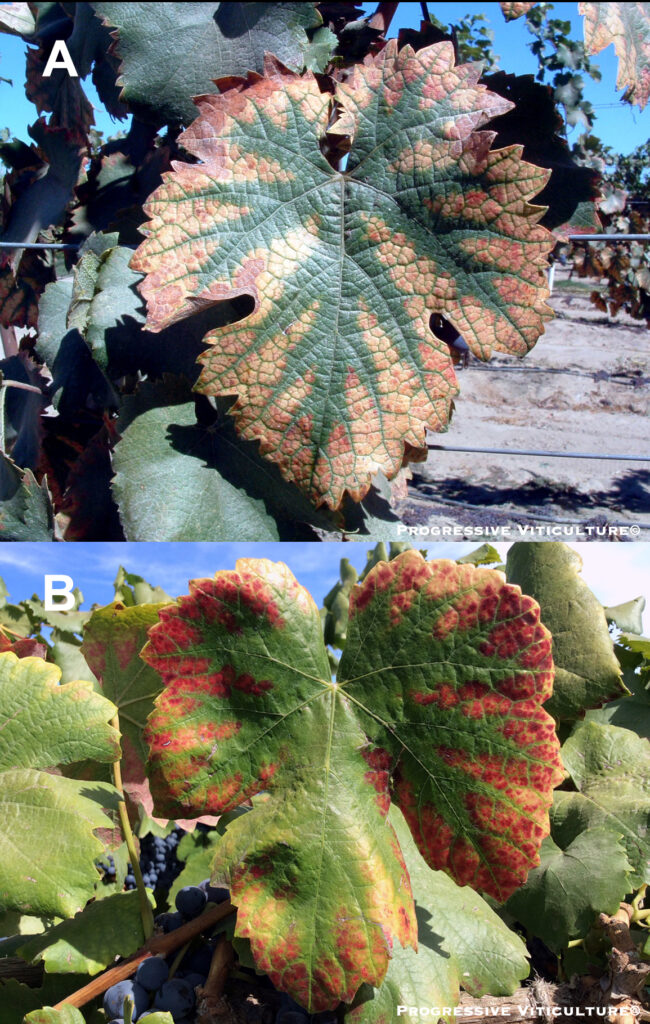
Magnesium deficiency-Symptoms are usually expressed in older basal leaves. Leaves become yellow on along the margin, while the tissue around the main veins of the leaf remains dark green. Red cultivars express reddening rather than yellowing. Magnesium deficiencies are common in vineyards with a high potassium-to-magnesium ratio and/or low pH in soils (<5.5 pH). Nutrient test of vines and soils followed by application of necessary nutrients and/or soil pH adjustment is recommended.
(Photo credit: Progressive Viticulture(R))
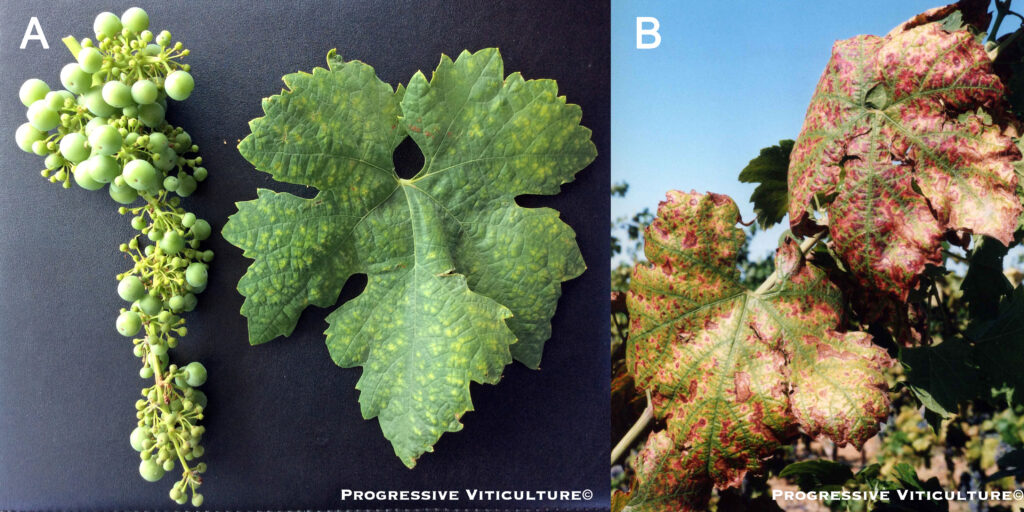
Boron deficiency-Symptoms can appear as dramatic stunting of the vine. Shoot growth can be compromised, leaves turn yellow, and fruit sets can become very poor. The initial symptoms may show up as dark knotty bulges form on tendrils near the shoot tips at bloom. It is observed on soils with high acidity (pH 3.5-4.5). Also, since boron is a soluble nutrient, it may be leached out from the soil, especially with sandy soils. Nutrient test of vines and soils followed by application of necessary nutrients and/or soil pH adjustment is recommended.
(Photo credit: Progressive Viticulture(R))
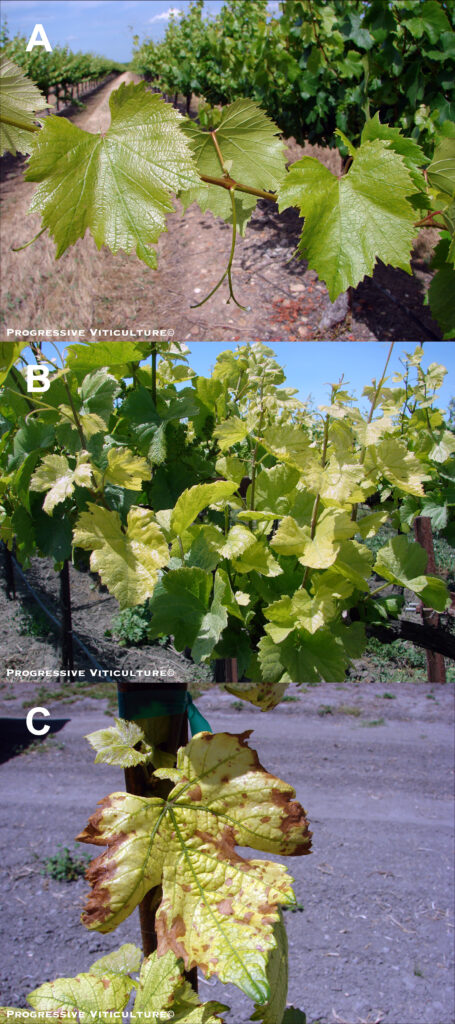
Iron deficiency-It is very common in vineyards with high pH soils. A symptom of iron deficiency is the fading of green color (due to loss of chlorophyll) from the edge of leaves, which progresses interveinally. This symptom is expressed throughout the season as yellowing of the leaves with veins remaining pale green. Iron can be applied as a foliar application, and the pH of the soil can also be adjusted. Nutrient test of vines and soils followed by application of necessary nutrients and/or soil pH adjustment is recommended.
(Photo credit: Progressive Viticulture(R))
Links:
Google Search on nutrient deficiency and Grapevine (will open a new window)
Google Scholar Search on nutrient deficiency and Grapevine (will open a new window)
Viruses
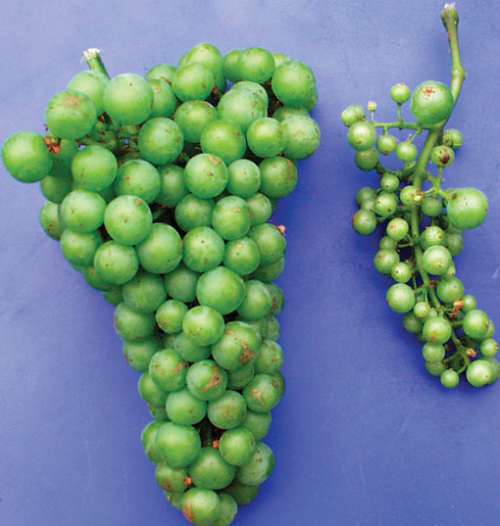
Tomato Ringspot Virus and Tobacco Ringspot Virus-Both viruses can cause irregular berry development, poor fruit set, and stunted shoots on infected grapevines. These viruses were vectored by a dagger nematode (Xiphinema americanum), and infected vines may result in death within 3 to 4 years. Resistant rootstocks, such as Kingfisher, Matador, and Minotaur, are available and recommended in eastern North America, where ToRSV infects many fruit crops and broad-leaf weed species.
(Photo credit: Michigan State Univ. Extension)
Links:
Google Search on ringspot virus and Grapevine (will open a new window)
Google Scholar Search on ringspot virus and Grapevine (will open a new window)
Pinot Gris Virus-This virus has been found in Pinot Gris, Pinot Noir, and Traminer so far. This virus causes young leaves to be malformed, yellow, and puckered and shoots to be stunted. Fruit quality and yields can be negatively affected by the infection.
Links:
Google Search on Pinot Gris virus and Grapevine (will open a new window)
Google Scholar Search on Pinot Gris virus and Grapevine (will open a new window)
Phytoplasmas
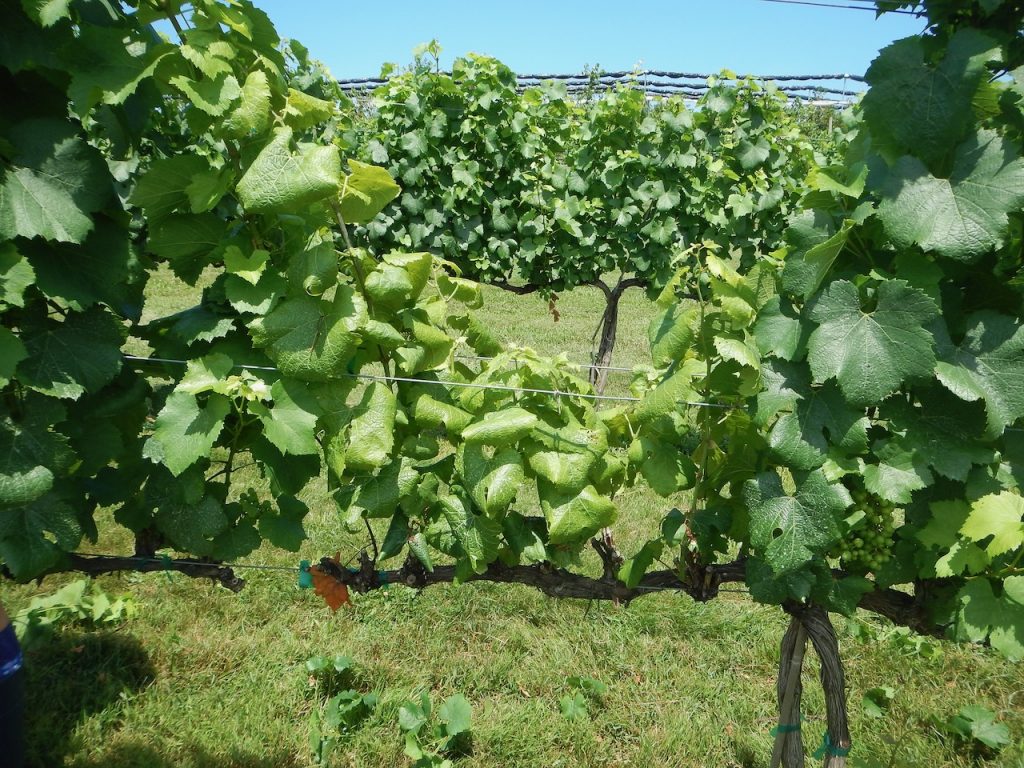
NAGY: North American Grapevine Yellows (NAGY) is caused by phytoplasmas. Symptoms are fruit abortion, yellowing and curling of leaves (especially with white-fruited cultivars), purplish hue on shoots, and irregular lignification.
More NAGY images
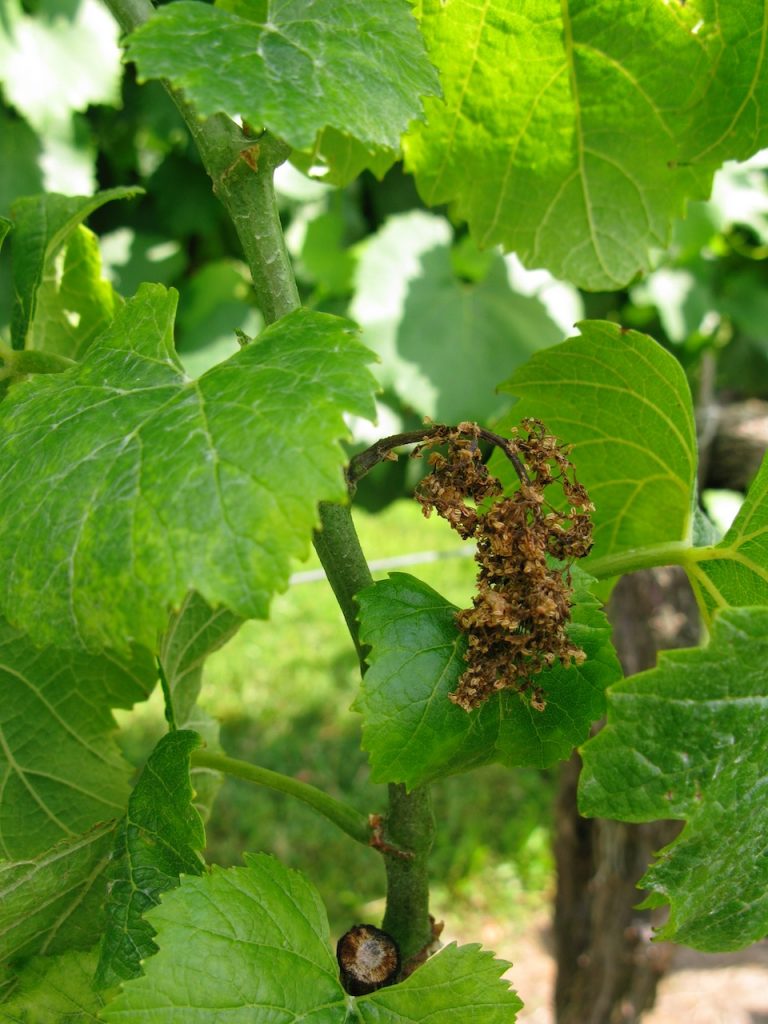


(Photo credit: Mizuho Nita)
Links:
Google Search on Grapevine Yellows (will open a new window)
Google Scholar Search on Grapevine Yellows (will open a new window)