Esca, also known as grapevine measles, Petri disease, or black goo, can slowly plague a vineyard into decline. Esca pathogens excrete toxins that trigger an array of symptoms. Measles-like symptoms (dark spots with purple halos) appear on fruit, especially on white-fruited cultivars, anytime from fruit set to harvest. Foliar toxin expression of esca appears as a tiger stripe pattern of interveinal necrosis with yellow or red margins. Cross-section of the infected trunk, cordon, and cane reveals black spots in the vascular system that may secrete black goo.
Severe cases exhibit shoot/tendril dieback and “apoplexy” or complete defoliation and fruit abortion. Spores enter pruning wounds and colonize the vascular system anytime from November to April. New infections can have symptom expressions in the same year, and symptoms become more prevalent in years of wet springs and hot summers.

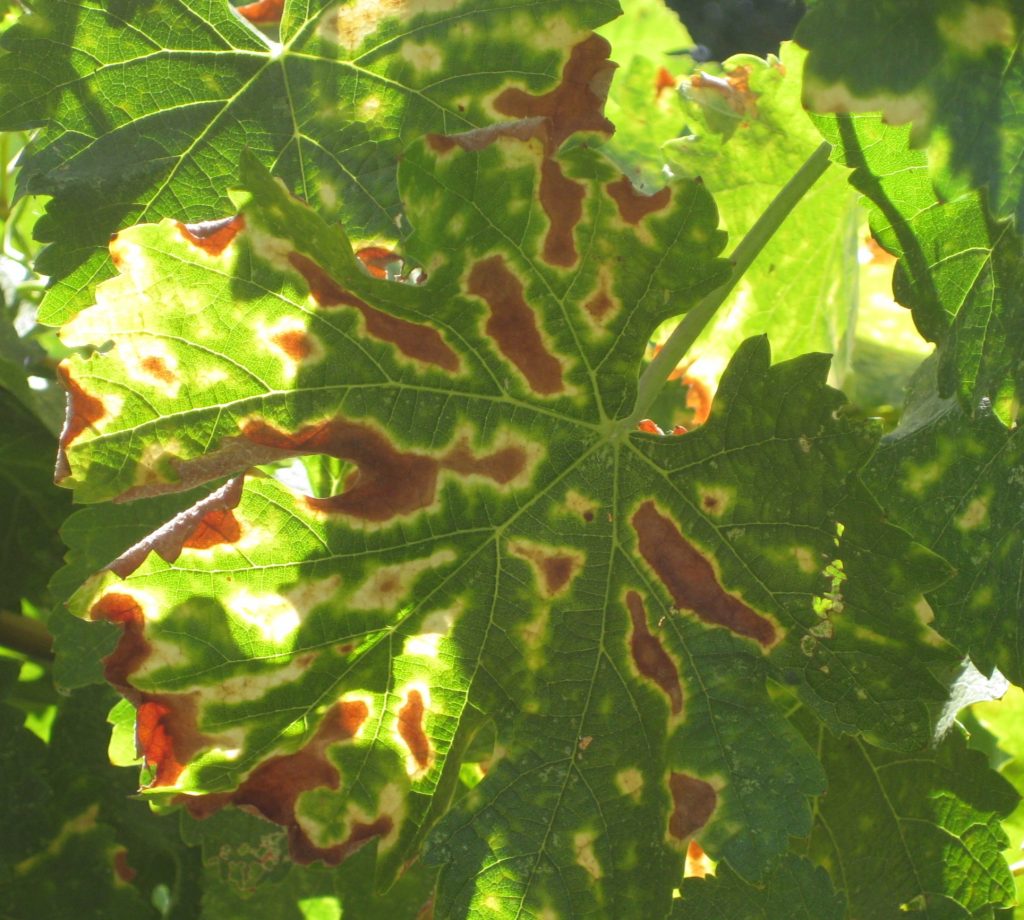

(Photo Credit: left: Renaud Travadon, right top: Monica Cooper, right bottom: Mizuho Nita)
Causal agent – Several genera of pathogens can cause Esca in grapevines. Phaeomoniella chlamydospora, Phaeoacremonium spp. and Toginia spp. are common species.
Management – The prevention at the time of winter pruning is the best approach for management. Double pruning, protection of pruning wound using paint with boron (trade name: B-Lock), as well as chemical control, such as the use of thiophanate-methyl (trade name: Topsin-M, FRAC = 1), myclobutanil (trade name: Rally, FRAC = 3), or tetraconazole (trade name: Mettle, FRAC = 3) to protect pruning wounds are known to reduce risk of infection to pruning wounds. Also, it is advised to prune vines on a day followed by several days of sunny conditions. I.e., avoid pruning before the rain. If you decide to use the aforementioned fungicides, make sure to obtain the label for the specific uses. Although symptoms appear in the vineyard after 5-10 years of planting, young vines are as susceptible as the old vines; therefore, it is advised to implement a management plan from the early years of the vineyard.
Remove the infected trunk or cordon arm 12 inches below the canker for unproductive vines and move the infected wood out of the vineyard for burying or burning. Vine health is extremely important for recovery after significant cordon or trunk pruning. Provide sufficient water and nutrients to encourage healthy vegetative growth.
Links:
Google Search on Esca and Grapevine (will open a new window)
Google Scholar Search on Esca and Grapevine (will open a new window)