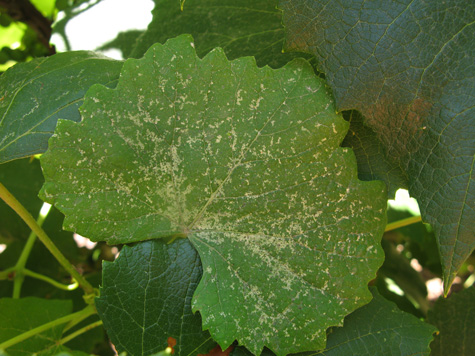
Leafhopper & other sap feeding insects – Adult and nymph grape leafhoppers feed on sap in leaf cells, leaving pale stippling marks on leaves. Severe feeding will cause leaves to turn from yellow to brown. More importantly, many of leafhoppers can transmit disease pathogens. Some examples are: glassy wing sharpshooter (Homalodisca vitripennis) that is one of vectors of Pierce’s disease; and Scaphoideus titanus that is one of vectors of grapevine yellows.
(Photo credit: utapests.usu.edu)
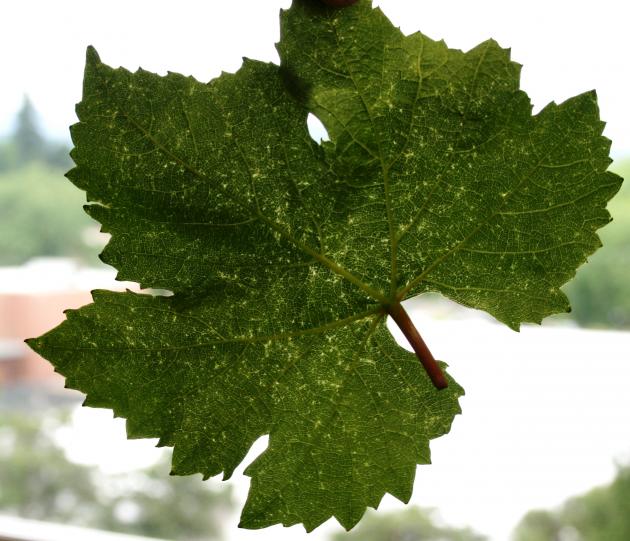
Mites – Grape rust mites (Calepitrimerus vitis Nalepa) can cause feeding injury on leaves. European red mites, Panonychus ulmi, cause chlorosis and bronzing by piercing and feeding on the leaf epidermis. Two-spotted spider mite feeds on the underside of leaves, causing yellow stippling on the top side of leaves.
(Photo credit: grapes.extension.org)
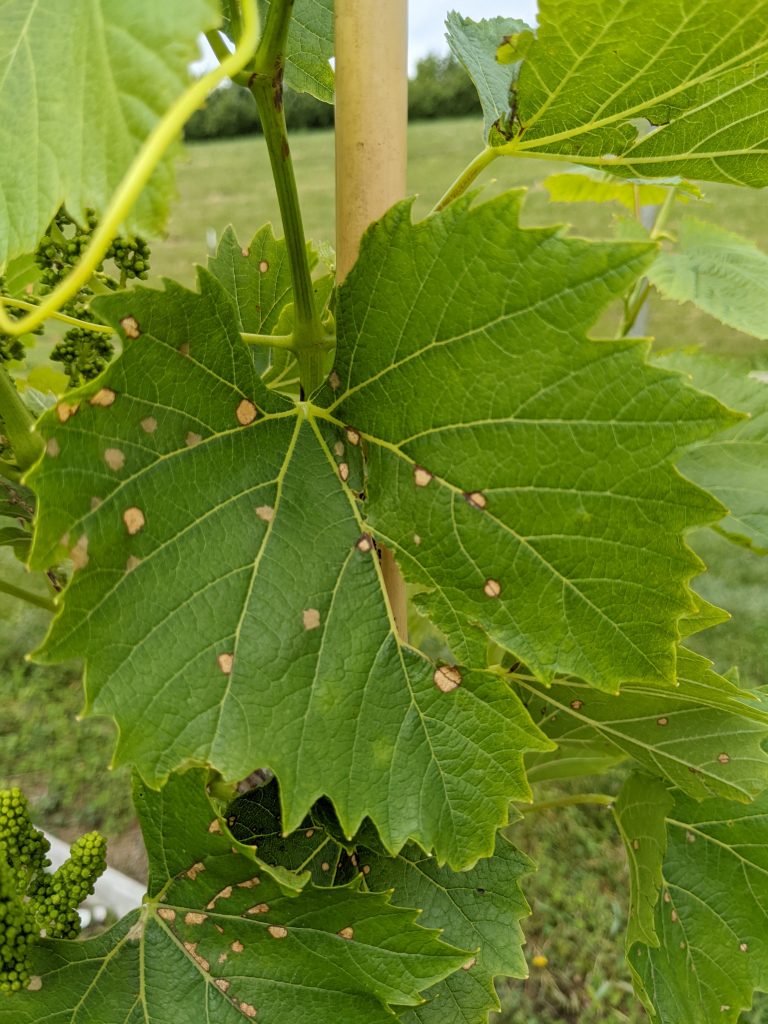
Early Black Rot infection presents itself as small, discolored lesions on leaves. The lesions turn brown and expand in time. Black fungal bodies called pycnidia develop in the lesion in a concentric pattern visible to the naked eye.
(Photo credit: Mizuho Nita)
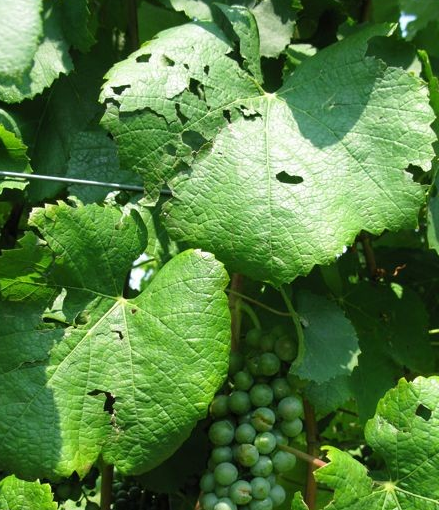
Hail – damage may cause shot holes and ripping of leaves, scarring on shoots as well as bruised and cracked fruit. Hail damage can easily reduce crop yield and quality through physical damage and by making fruit vulnerable to secondary infection.
(Photo credit: Mizuho Nita)